
If you are still treating keyword research like a spread-sheet exercise from 2018, you’re already behind.
Search has changed. Users have changed. And most importantly, Google has changed how it understands intent, context, and content quality.
This guide cuts through the noise and focuses on what actually works in 2026, whether you’re running an e-Commerce store, a content site, or something in between.
How search engines work
At a basic level, search engines still follow the same three-step process:
- Crawling – discovering pages
- Indexing – storing and understanding content
- Ranking – deciding what shows up and in what order
What’s different now is how they interpret content.
Google no longer relies heavily on exact-match keywords. Instead, it uses:
- Semantic understanding (topics, entities, relationships)
- User intent modelling
- Behaviour signals (clicks, dwell time, pogo-sticking)
- Context (location, device, previous searches)
What this means for keyword research
You are no longer targeting keywords. You are targeting intent clusters.
If someone searches:
- “best running shoes”
- “top trainers for long distance”
- “good shoes for marathon training”
Google sees these as variations of the same need.
If your strategy is still “one keyword per page”, you’re wasting effort.
How Algorithm changes affect strategy
Google updates constantly, but recent trends are clear:
1. Intent > keywords
Content that satisfies intent wins, even if it does not perfectly match the query.
2. Topical authority matters
Sites that consistently cover a subject area outperform one-off articles.
3. Content quality signals are stronger
Thin content gets ignored. Over-optimised content gets filtered.
4. SERP features steal clicks
Featured snippets, AI summaries, product carousels, your keyword might rank #1 and still get fewer clicks.
Effective keyword research methods in 2026
Let’s be honest: most keyword research advice is outdated. Here’s what actually moves the needle.
1. Start with real user intent (Not tools)
Forget tools for a minute.
Ask:
- What problem is the user trying to solve?
- What stage are they in? (research vs ready to buy)
- What would actually satisfy them?
Then validate with data.
2. Use SERPs as your primary research tool
Google is the best keyword tool.
Search your target term and analyse:
- What type of content ranks? (guides, product pages, comparisons)
- How deep are the articles?
- What questions are answered?
- What’s missing?
If your content does not match the format Google already prefers, it will not rank.
Google Autocomplete
Start typing your keyword into Google and pay attention to the suggestions. These are not random, they are pulled from actual search behaviour at scale.
For example, typing “running shoes” surfaces modifiers like:
- women / men
- brand-specific (nike, hoka, adidas, asics)
- commercial intent (sale, uk)
- problem-based (for overpronation)
- audience-based (for kids)
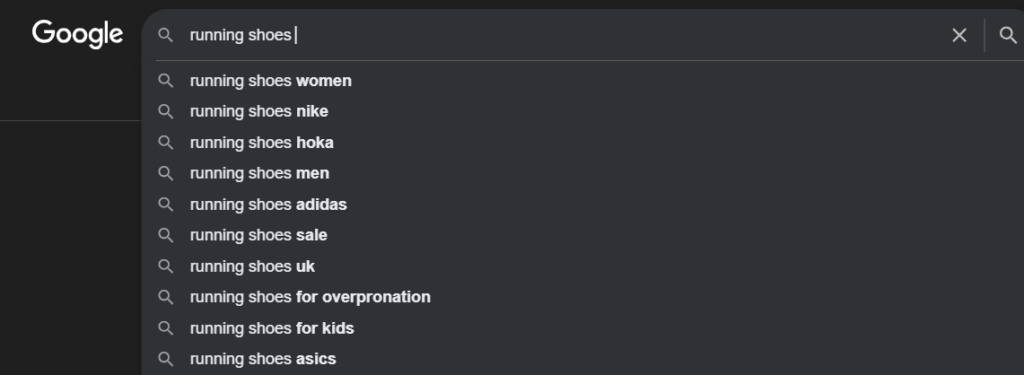
This is pure gold for keyword research because it reveals:
- Segmentation opportunities (gender, location, age group)
- Buying intent vs informational intent
- Brand vs non-brand demand
- Specific use cases and pain points
How to use this properly:
- Turn each modifier into its own page or section (don’t lump everything into one generic article)
- Map intent:
- “running shoes sale” → transactional page
- “running shoes for overpronation” → problem-solving guide
- “running shoes nike” → brand comparison or collection page
- Identify gaps competitors miss (e.g., many ignore niche segments like kids or specific conditions)
Rule:
If Google suggests it, people are searching it, and if people are searching it, you should either target it or intentionally decide not to.
Ignoring autocomplete is leaving easy traffic on the table.
3. Build topic clusters, not isolated keywords
Instead of:
- One page per keyword
Do this:
- One core topic page
- Supported by related subtopics
Example:
Main:
- “Keyword research guide”
Supporting:
- “Keyword research tools”
- “How to find low competition keywords”
- “Keyword research for e-Commerce”
This builds authority and improves internal linking.
4. Look beyond search volume
Search volume is misleading.
Focus on:
- Commercial intent (will this convert?)
- Ranking difficulty (can you realistically compete?)
- SERP quality (are results weak or strong?)
A 200-search keyword with high intent beats a 10,000-search vanity term every time.
5. Mine first-party data
Your best keywords are already in your data.
Use:
- Google Search Console
- Site search data
- Customer queries
- Sales/support conversations
These show real language from real users, far more valuable than tool estimates.
How keyword research changes by site type
Not all keyword strategies are equal. What works for a blog will not work for a product-led site.
eCommerce sites
Focus on:
- Transactional keywords (“buy”, “best price”, “discount”)
- Product-specific queries
- Category-level optimisation
What works:
- Optimised category pages
- Comparison content (“X vs Y”)
- Buying guides
What does not work:
- Thin product descriptions
- Over-reliance on manufacturer content
Informational / blog sites
Focus on:
- Problem-solving queries
- Long-tail keywords
- Topic depth
What works:
- Comprehensive guides
- Clear structure
- Answering multiple related questions in one piece
What does not work
- Chasing volume without intent
- Writing shallow content for dozens of keywords
Service-based businesses
Focus on:
- Local + intent-driven keywords
- Service-specific pages
What works:
- Location pages (done properly)
- Clear service breakdowns
- Trust signals (reviews, case studies)
What does not work:
- Generic “we offer everything” pages
- Keyword stuffing locations
Using Google Search Console properly
Google Search Console is one of the most powerful tools you have, and most people barely scratch the surface.
What to look for
- Queries You’re Already Ranking For
- Especially positions 5 – 20
- These are your easiest wins
- High Impressions, Low Click-Through Rate
- Improve titles and meta descriptions
- Align content better with intent
- Pages Ranking for Multiple Keywords
- Expand content to fully cover the topic
- Strengthen internal links
Practical workflow
- Export query data
- Group similar queries by intent
- Map them to existing or new pages
- Improve or expand content accordingly
This is how you turn data into rankings, not guesswork.
Common mistakes that still happen
Let’s be blunt, these kill performance:
- Chasing high-volume keywords without considering competition
- Writing content without checking the SERP first
- Creating multiple pages targeting the same intent
- Ignoring internal linking
- Over-optimising with exact-match keywords
If your strategy includes any of these, fix them first.
What actually works right now
If you strip everything back, effective keyword research in 2026 comes down to this:
- Understand intent, not just keywords
- Use Google itself as your research tool
- Build topical authority, not isolated pages
- Leverage your own data (especially Search Console)
- Match content format to what already ranks
That’s it. Everything else is just detail.
Final thought
Keyword research is not dead, it has just evolved.
The people still doing it like it is 2015 are the same ones wondering why their content does not rank.
If you focus on intent, depth, and relevance, you will outperform most of your competition, because most of them are still doing it wrong.