Search engines have become far better at understanding trust, authority, relevance, and manipulation. A backlink that improved rankings five years ago may now have little value or even create risk.
In 2026, high-quality link building is no longer about volume. It is about earning links that demonstrate credibility, relevance, and genuine authority within a topic.
Businesses that continue chasing cheap directory links, private blog networks, or automated outreach campaigns often struggle to compete against brands earning editorial mentions from trusted sources.
For companies investing seriously in SEO, understanding backlink quality matters more than ever.
Why backlinks still matter
Backlinks remain one of the strongest ranking signals in modern SEO.
When a respected website links to another website, it acts as a signal of trust. Search engines use these signals to help determine:
- Which businesses deserve visibility
- Which pages demonstrate expertise
- Which websites are trusted within an industry
- Which content provides genuine value
However, not all backlinks pass equal value.
One highly relevant backlink from a trusted industry publication can outperform hundreds of weak links from unrelated websites.
That is the major difference between effective SEO and out-dated link building.
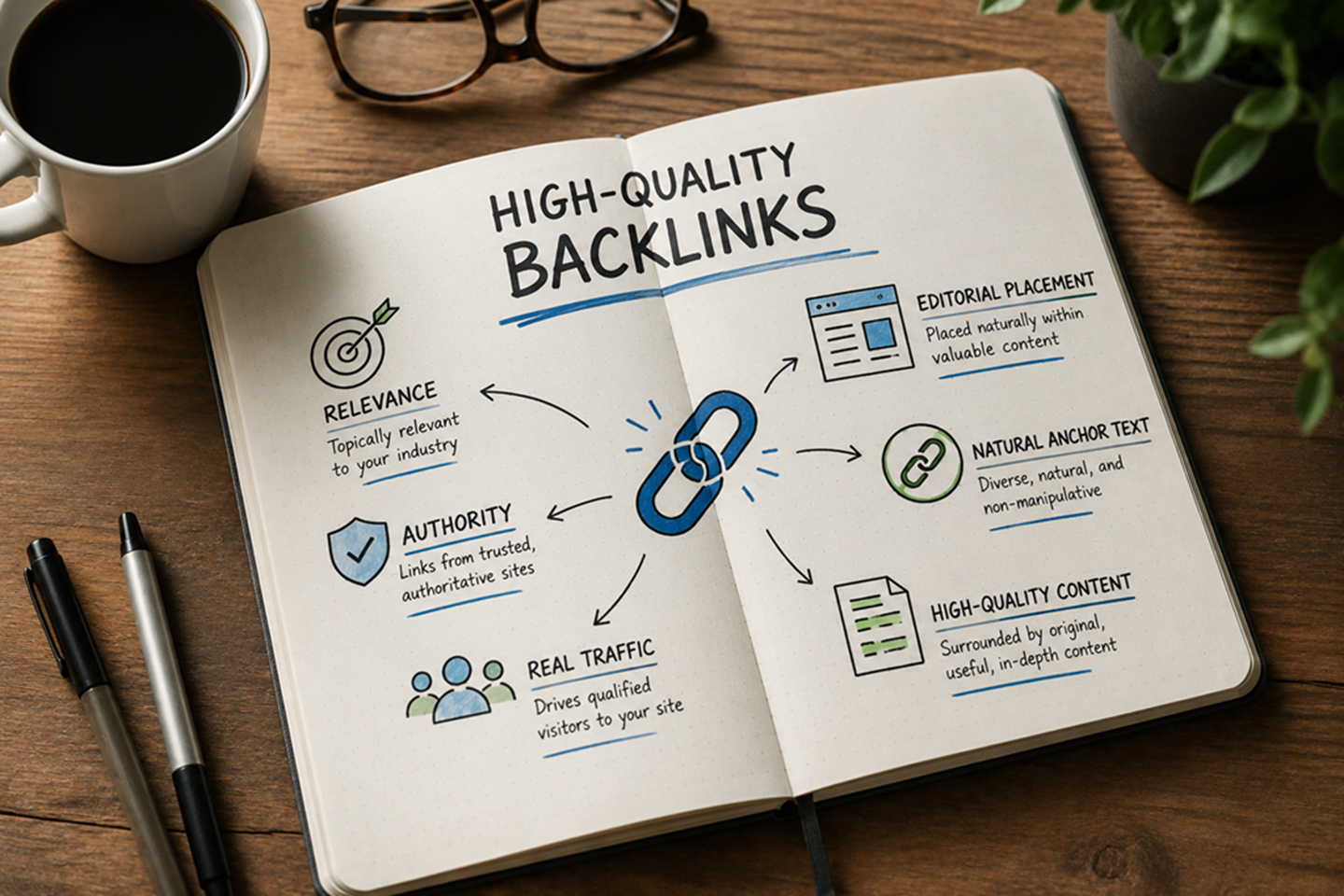
The core traits of a high-quality backlink
1. Topical relevance
Relevance has become one of the most important factors in modern link evaluation.
A backlink from a website closely connected to your industry carries far more value than a random mention from an unrelated site.
For example:
- A legal firm receiving a link from a respected legal publication is highly relevant
- A fitness website linking to an accountancy firm provides little contextual value
- A local tradesman mentioned by a regional property website creates strong local relevance
Search engines now understand topical relationships exceptionally well. They evaluate:
- Website themes
- Page content
- Related entities
- Subject expertise
- Semantic relevance
The closer the relationship between the linking site and the target page, the stronger the signal becomes.
2. Editorial placement
Editorial backlinks remain among the most powerful links in SEO.
These are links placed naturally within useful content because the referenced page adds value for readers.
Examples include:
- Industry publications
- Expert interviews
- News articles
- Research citations
- In-depth guides
- Case studies
Editorial links are difficult to manipulate, which is exactly why they carry weight.
Search engines place less trust in backlinks that appear:
- In footers
- On spam-heavy directories
- Within obvious sponsored content
- Across large-scale guest posting networks
- On thin affiliate websites
Context matters greatly in 2026.
3. Website authority and trust
Authority still plays an important role, but it is no longer purely about domain metrics.
A trusted website typically demonstrates:
- Strong organic visibility
- Genuine traffic
- Consistent publishing standards
- Real audience engagement
- Brand recognition
- Editorial oversight
Search engines increasingly assess whether a website appears legitimate and trustworthy overall.
This means a niche industry publication with genuine authority can often outperform a large but low-trust website.
Quality matters more than raw domain scores.
4. Traffic potential
The best backlinks do not just influence rankings. They also send qualified traffic.
A valuable backlink should have the potential to generate:
- Relevant visitors
- Leads
- Brand awareness
- Engagement
- Conversions
If a backlink sits on a page nobody visits, its practical SEO value may be limited.
Strong links often appear on pages that already rank and receive traffic themselves.
This is where tools such as Semrush become extremely useful.
Using Semrush, you can:
- Analyse backlink profiles
- Review referring domains
- Identify toxic links
- Examine anchor text usage
- Discover competitor backlinks
- Assess organic traffic estimates
- Find authoritative outreach opportunities
Rather than relying on guesswork, SEO professionals can use real data to evaluate whether a backlink opportunity is genuinely worthwhile.
5. Natural anchor text
Anchor text remains important, but over-optimisation creates risk.
In the past, many websites aggressively targeted exact-match keyword anchors to manipulate rankings.
That approach now appears unnatural.
Healthy backlink profiles usually contain a mixture of:
- Brand anchors
- Natural phrases
- Generic anchors
- URL anchors
- Partial keyword anchors
For example, branded anchors often appear far more natural than repeatedly forcing commercial keywords into every link.
Modern SEO requires balance and credibility.
6. Link placement within content
Where a backlink appears on a page also influences quality.
Links placed naturally within the main body content tend to carry stronger value than links placed in:
- Sidebars
- Footers
- Author bios
- Sitewide navigation
Search engines evaluate whether the link genuinely supports the surrounding content.
A contextual link embedded within a useful paragraph usually signals editorial intent more effectively.
7. Original content around the link
Thin content weakens backlink value.
High-quality backlinks are normally surrounded by strong supporting content that demonstrates expertise and usefulness.
Search engines increasingly assess:
- Content depth
- Original insights
- Author credibility
- User engagement
- Information quality
A backlink within a genuinely useful article carries far greater trust than one placed inside low-value filler content created purely for SEO purposes.
What makes a backlink low quality in 2026?
Understanding harmful links is equally important.
Low-quality backlinks often come from:
- AI-generated spam blogs
- Expired domain networks
- Irrelevant directories
- Link farms
- Automated outreach schemes
- Websites with no organic visibility
- Thin affiliate sites
- Foreign-language spam pages unrelated to your market
Google’s systems have become highly effective at identifying manipulative patterns.
Many poor-quality links are now simply ignored. Others can still damage trust signals if abuse becomes excessive.
That is why modern SEO campaigns focus heavily on quality control.
Why digital PR has become so important
Digital PR continues to grow because it naturally earns the types of backlinks search engines trust most.
Strong digital PR campaigns can generate links from:
- National news websites
- Industry publications
- Local media
- Expert commentary features
- Data-driven research pieces
These links often combine:
- High authority
- Strong relevance
- Real traffic
- Editorial trust
That combination is difficult to replicate with traditional link building tactics.
How SEO professionals evaluate backlink opportunities
Experienced SEO consultants rarely evaluate backlinks using a single metric.
Instead, they assess a combination of factors including:
- Relevance
- Organic traffic
- Link placement
- Content quality
- Website trust
- Spam signals
- Indexation
- Audience quality
- Editorial standards
Tools such as Semrush help speed up this analysis, but manual review remains essential.
A website may display strong metrics while still appearing manipulative or low quality when reviewed properly.
That human judgement still matters greatly.
The future of link building
The direction of SEO is clear.
Search engines increasingly reward:
- Brand authority
- Expertise
- Trust
- Real audience signals
- Editorial mentions
- High-value content
The businesses achieving the best SEO results in 2026 are not chasing shortcuts.
They are building visibility through:
- Strong content
- Genuine expertise
- Digital PR
- Industry relationships
- Useful resources
- Trustworthy branding
Backlinks remain essential, but the standards have become far higher.
Final thoughts
A high-quality backlink in 2026 is not simply a link from a website with a strong metric score.
It is a trusted editorial recommendation from a relevant website that adds value for real users.
The strongest backlinks combine:
- Relevance
- Authority
- Context
- Trust
- Traffic potential
- Natural placement
Businesses that focus on earning these links consistently build stronger long-term SEO performance.
Those relying on out-dated link schemes often find themselves falling behind.
Modern link building is no longer about manipulation. It is about credibility.