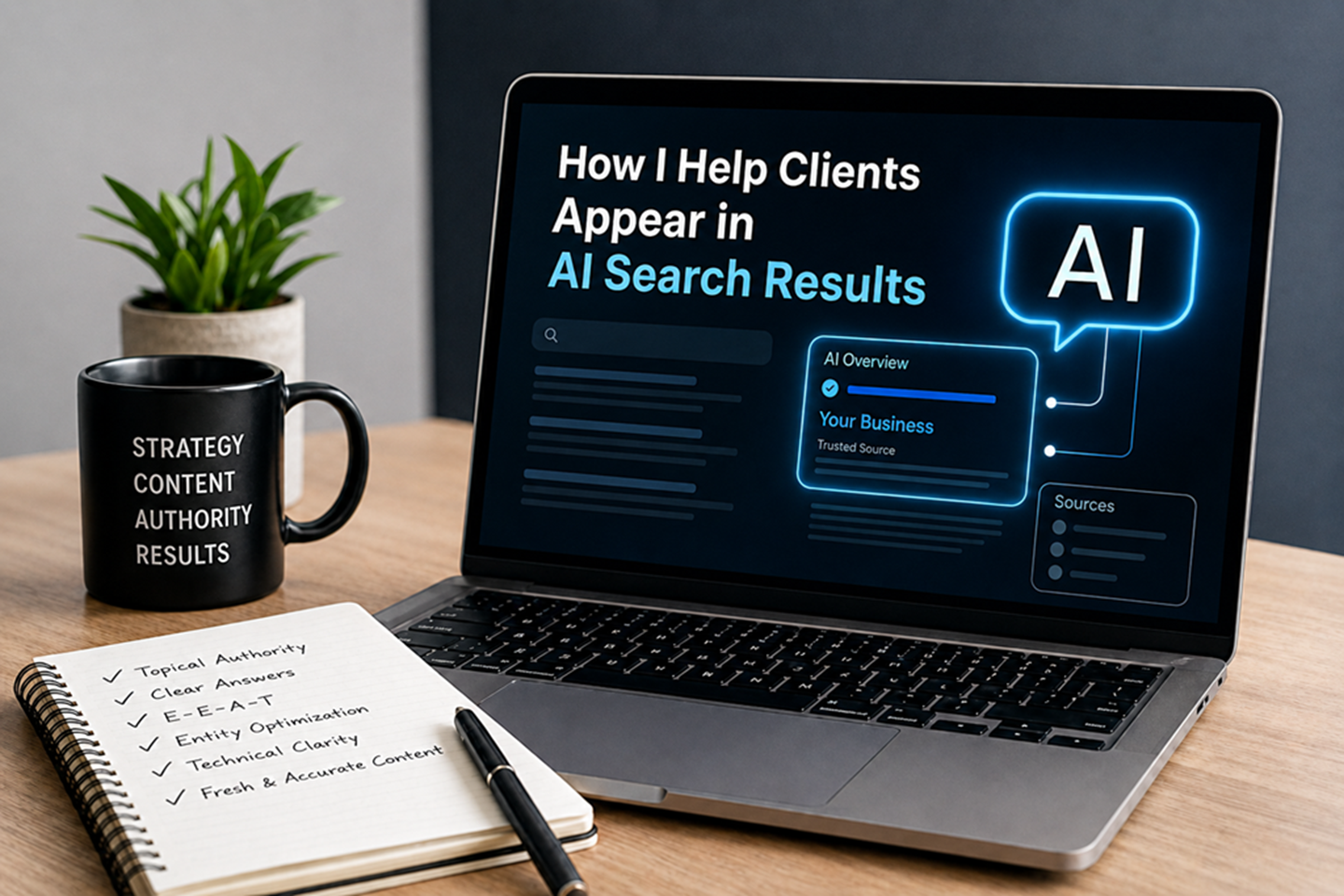
Search has changed. Traditional rankings still matter, but visibility now extends beyond blue links. Platforms like AI-driven search summaries and conversational tools decide which sources to trust, extract, and present. I have adapted my SEO approach to meet that shift, and the results speak for themselves: clients appearing in AI-generated answers, not just ranking pages.
This post explains exactly how I have done it.
Understanding what AI search systems value
AI search tools do not rank pages in the same way as traditional search engines. They extract, summarise, and recombine information. That means they prioritise:
- Clear, structured content
- Demonstrated expertise
- Consistent topical authority
- Trusted sources and references
- Entities and context over keywords alone
If a page is difficult to interpret or lacks depth, it is unlikely to be used.
My approach to SEO for AI visibility
1. Building topical authority, not just pages
Instead of targeting isolated keywords, I build clusters of content around a subject.
For example, if a client operates in property law, I do not stop at one page. I create a network of pages covering:
- Processes
- Costs
- Legal requirements
- Common issues
- Regional differences
Each page links logically to the others. This signals expertise and depth, which AI systems favour when selecting sources.
2. Writing for extraction, not just ranking
AI tools pull direct answers from content. I structure pages so that key information can be lifted easily.
This includes:
- Clear headings that mirror real questions
- Direct answers immediately after headings
- Short, precise paragraphs
- Lists where appropriate
I avoid vague introductions and get straight to the point. If a section answers a question cleanly, it increases the chance of being used in AI summaries.
3. Strengthening E-E-A-T signals
Experience, Expertise, Authoritativeness, and Trust are not optional.
I reinforce these through:
- Author profiles with real credentials
- Case studies with measurable results
- External citations where relevant
- Consistent branding and messaging
AI systems look for signals that content comes from a credible source. Weak authority means reduced visibility, regardless of keyword optimisation.
4. Entity optimisation
Search has moved beyond keywords to understanding entities and relationships.
I ensure that content clearly defines:
- Who the business is
- What it does
- Where it operates
- How it relates to its industry
This includes structured data, consistent naming, and contextual mentions across the site. When AI tools understand the entity, they are more likely to surface it in responses.
5. Technical clarity and accessibility
Even the best content fails if it is difficult to crawl or interpret.
I prioritise:
- Clean HTML structure
- Fast loading speeds
- Mobile usability
- Logical internal linking
AI systems rely on well-structured data. Technical issues reduce the likelihood of content being selected.
6. Updating content for accuracy and freshness
AI tools favour content that is current and reliable.
I regularly:
- Update statistics and references
- Expand pages with new insights
- Remove out-dated sections
This maintains trust signals and keeps content relevant for both users and AI systems.
Example: Appearing in AI results for a commercial query
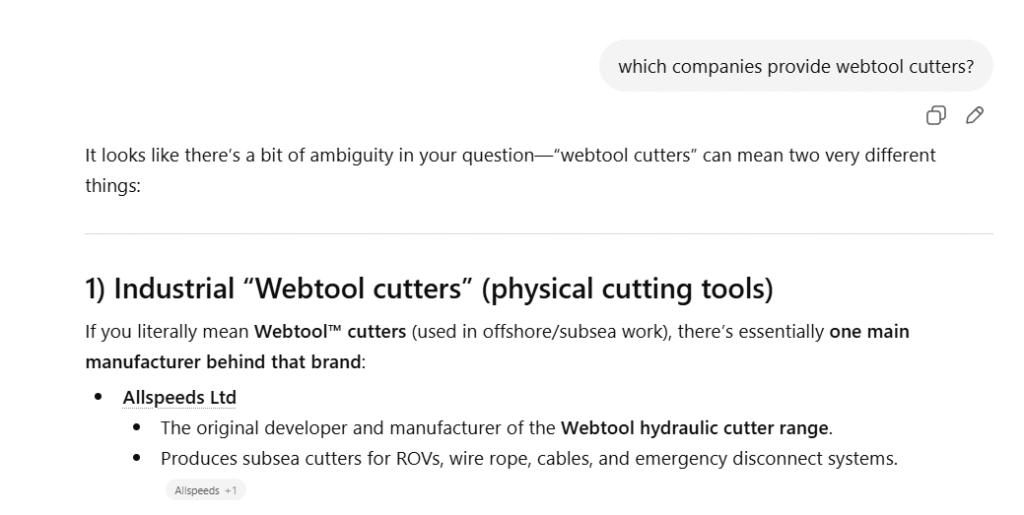
A recent example of this approach in action is my work with allspeeds.co.uk.
When searching “which companies provide webtool cutters” in AI-driven platforms such as ChatGPT, Allspeeds is surfaced as a relevant supplier. This is not by chance. It is the result of a structured SEO strategy designed specifically for AI extraction and recommendation.
To achieve this, I focused on a few key areas.
First, I ensured the site clearly demonstrated subject matter expertise around precision tooling and webtool cutters. This involved creating content that directly answers commercial and technical queries, rather than relying on generic product descriptions.
Second, I structured the content so that it could be easily interpreted and extracted. Pages were built around real search questions, with concise answers and supporting detail. This makes it easier for AI systems to identify Allspeeds as a reliable source when generating responses.
Third, I strengthened entity signals. The business is consistently defined across the site as a supplier of specific tooling solutions, with clear context around its products, industries served, and capabilities. This helps AI systems connect the brand to relevant queries.
Finally, I supported this with internal linking and topical depth. Instead of a single page targeting webtool cutters, the site builds a broader context around related tooling and applications. This reinforces authority and increases the likelihood of being selected as a source.
The result is visibility where it matters. Not just rankings, but inclusion in AI-generated answers for commercially valuable queries.
Another example: Service-based visibility in AI search
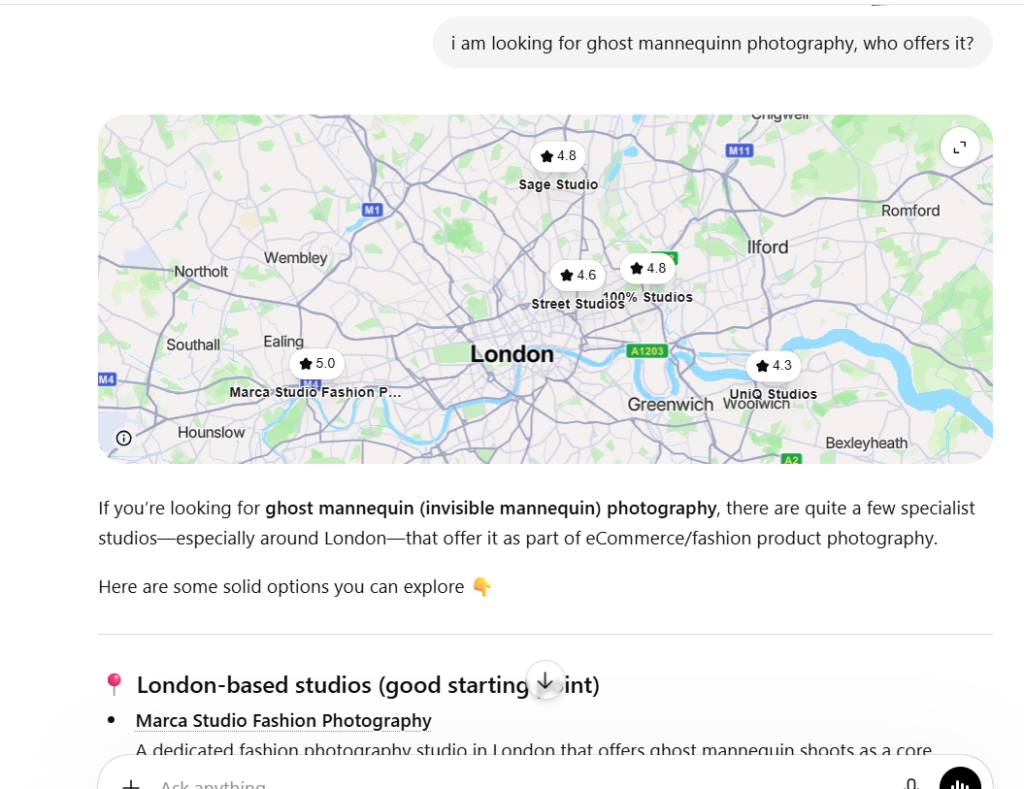
Another strong example is my work with marcafashionphotography.
When searching “I am looking for ghost mannequin photography, who offers it” within AI platforms such as ChatGPT, Marcafashionphotography appears as a relevant provider. This demonstrates how the same principles apply beyond products and into service-based businesses.
This visibility was achieved through a focused content and entity strategy.
I built out content that directly addresses what ghost mannequin photography is, who it is for, and how it works. Instead of relying on a single service page, the site provides clear, structured information that answers both commercial and informational intent.
Each section is written in a way that AI systems can easily extract. Key questions are answered directly, with supporting detail that reinforces expertise without adding unnecessary filler.
Entity clarity also plays a critical role. The business is consistently positioned as a specialist in fashion photography, with strong contextual relevance around ghost mannequin services. This helps AI systems confidently associate the brand with that specific query.
I also ensured that the content reflects real-world experience. Examples of work, process explanations, and industry-specific language all contribute to stronger trust signals.
The result is the same as with product-based clients: inclusion in AI-generated answers for high-intent searches. This drives more relevant enquiries and positions the business as a recognised provider at the point of decision-making.
Real outcome: Visibility beyond rankings
The result of this approach is not just improved rankings. Clients begin to appear:
- In AI-generated summaries
- As cited sources in conversational tools
- Within enhanced search features
This drives qualified traffic, strengthens brand authority, and positions the business as a trusted source in its field.
What this means for your SEO strategy
If your strategy is still focused purely on keywords and rankings, it is already behind.
To compete in modern search, you need:
- Depth over volume
- Clarity over complexity
- Authority over shortcuts
AI search is not replacing SEO. It is raising the standard.
Final thoughts
This shift is not temporary. AI-driven search will continue to evolve, and the gap between high-quality and average content will widen.
My approach is built around that reality. It focuses on creating content that is not only discoverable but also usable by AI systems.
If your goal is to appear where users are actually getting answers, this is the direction that works.