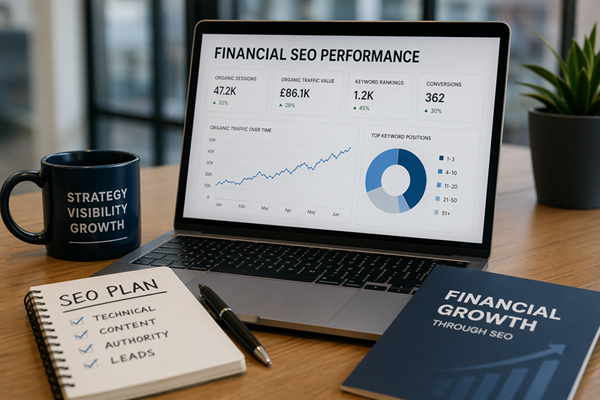
The financial services space is one of the most competitive sectors online. I see it time and time again: strong businesses with excellent products failing to generate enquiries simply because they are not visible in search.
If you operate in mortgages, loans, insurance, investments or any regulated financial niche, SEO is not optional. It is the difference between consistent inbound leads and relying entirely on paid channels.
The reality of search in financial services
Most financial search terms are brutally competitive. High cost-per-click values alone prove how valuable this traffic is. When businesses are willing to spend heavily on ads, it tells you one thing: organic visibility is even more valuable.
The challenge is simple:
- If you are not in the top three results, you are barely seen
- If you are on page two, you are effectively invisible
Click-through rates drop off sharply even within page one, meaning the majority of traffic goes to just a handful of websites .
That is why a proper SEO strategy is not about “ranking somewhere”. It is about dominating high-intent positions.
Why financial SEO is different
SEO in finance is not the same as other industries. There are three key reasons:
1. Regulation and compliance
Content must meet strict standards, particularly under FCA guidelines. You cannot publish aggressive or misleading content. Everything must be accurate, transparent and compliant.
2. YMYL (Your Money Your Life)
Google treats financial content as high risk. This means your website must demonstrate:
- Expertise
- Authority
- Trust
Weak or generic content will not rank in this space.
3. Authority competition
You are competing against:
- Major banks
- Comparison platforms
- Established financial brands
These sites have strong backlink profiles and years of domain trust.
If your SEO approach is basic, you will not compete.
What actually drives results in financial SEO
There is a lot of noise in SEO. For financial services, the fundamentals are clear and non-negotiable.
Technical SEO comes first
If your website has structural issues, nothing else works properly.
A proper audit should cover:
- Site performance and Core Web Vitals
- Mobile usability
- Internal linking structure
- Indexation issues
- URL structure
Most finance websites I review have underlying technical problems that hold everything back.
Content must match intent
It is not about writing more content. It is about writing the right content.
High-performing financial SEO content:
- Targets specific search intent
- Answers real user questions
- Demonstrates expertise and accuracy
- Is structured for both users and search engines
Generic blog posts do not generate leads.
Keywords that convert (not just traffic)
One of the biggest mistakes I see is chasing volume.
Traffic alone means nothing.
A smaller number of highly targeted visitors with intent to act will always outperform large volumes of unqualified traffic. As the principle goes: traffic is vanity, profit is sanity .
Link building and digital PR
In finance, authority is everything.
You need:
- High-quality backlinks from relevant sites
- Digital PR campaigns that build credibility
- Consistent authority growth over time
Without this, rankings will stall regardless of how good your on-site SEO is.
SEO vs paid ads in financial services
Paid ads have their place, but they come with limitations:
- Costs scale quickly
- Leads stop when spend stops
- Competition drives prices higher
SEO works differently.
Once you rank:
- Traffic is consistent
- Cost per lead drops significantly
- Visibility is not tied to budget
For high CPC sectors like finance, this becomes a major competitive advantage.
Common reasons financial SEO fails
If you have invested in SEO before and it did not work, it is usually down to one of the following:
- Underinvestment in a competitive market
- Poor quality content
- Weak or spammy link building
- Lack of technical foundations
- Slow implementation due to internal approvals
- Unrealistic expectations on timelines
SEO in finance is not quick or cheap. But done properly, it is one of the most profitable channels available.
How long does financial SEO take?
There is no fixed answer, but in most cases:
- Early improvements: 3–6 months
- Strong traction: 6–12 months
- Market-leading positions: 12+ months
This depends on:
- Competition
- Website history
- Budget
- Execution quality
Any provider promising instant results should raise concerns.
The end goal: Qualified leads, not rankings
Rankings are only part of the picture.
The real objective is:
- More enquiries
- Higher quality leads
- Improved conversion rates
- Stronger ROI
A successful financial SEO strategy aligns search visibility with commercial outcomes.
Final thoughts
Financial SEO is complex, competitive and heavily regulated. That is exactly why it works so well when done properly.
If your website is not generating the level of enquiries it should be, the issue is rarely your service. It is visibility. Fix that, and everything else becomes easier.