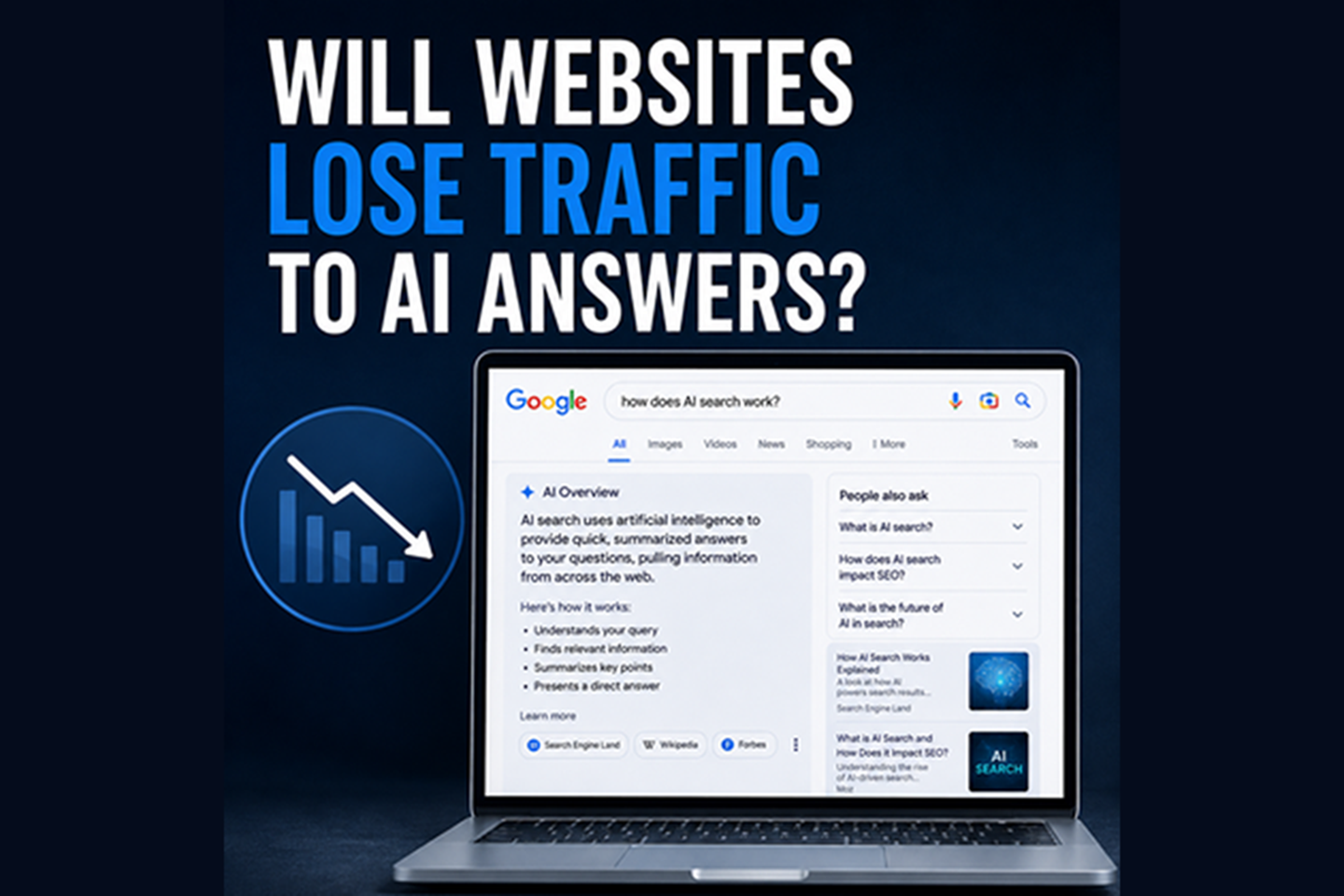
Search behaviour is changing faster than most businesses realise.
For years, Google worked as a gateway to websites. A user searched for something, scanned the results, then clicked through to a page for the answer. That model is now shifting because AI-generated answers are removing the need to visit websites in the first place.
Google AI Overviews, ChatGPT, Perplexity, Gemini and other AI-driven platforms are increasingly delivering direct answers inside the search experience. Users get information immediately without clicking through to a publisher, business website or blog.
The result is simple: many websites are already losing organic traffic.
The bigger question is not whether this change is happening. It is whether businesses adapt quickly enough to survive it.
AI search is already reducing clicks
The data around AI search visibility is becoming difficult to ignore.
Ahrefs analysed 300,000 keywords and found that Google AI Overviews reduced click-through rates for the top organic result by 34.5%. Later research showed that impact increasing to as much as 58% for some searches.
Pew Research also found users were far less likely to click traditional search listings when AI-generated summaries appeared in results.
This matters because informational content drives a large percentage of website traffic for publishers, affiliate sites, SaaS businesses and service companies.
If AI provides the answer instantly, fewer users visit the source.
That does not mean SEO is dead. It means SEO is changing.
Which websites are most at risk?
Not every website will be affected equally.
Websites relying heavily on informational search traffic face the biggest threat. This includes:
- Affiliate websites
- News publishers
- Blog-driven lead generation sites
- Recipe websites
- How-to content publishers
- Comparison websites
- Dictionary and glossary pages
AI systems are extremely effective at summarising factual information. If content exists purely to answer simple questions, AI can often replace the need for a visit entirely.
For example, searches such as:
- “How many calories are in a banana?”
- “What is technical SEO?”
- “How to reset an iPhone”
- “Best time to post on Instagram”
Can now be answered directly inside Google.
That traffic loss is already happening across many industries.
Why commercial searches still matter
Transactional and commercial searches remain more resilient.
Users researching products, comparing services or preparing to spend money still need deeper information, reviews, pricing and trust signals before making decisions.
AI can summarise options, but it still struggles with:
- First-hand experience
- Genuine expertise
- Unique opinions
- Product testing
- Local knowledge
- Brand trust
- Real case studies
This is why authority matters more than ever.
Businesses that build genuine expertise and reputation across their industry are far more likely to remain visible in both traditional search and AI-generated answers.
Google still needs websites
There is an important detail many people overlook. AI systems cannot function without content creators.
Google AI Overviews pull information from websites. ChatGPT references publisher content. Perplexity cites sources. AI models require a constant stream of fresh, reliable information to stay useful. If publishers stop creating content because traffic disappears, the quality of AI answers eventually declines.
Google knows this.
That is why AI Overviews still include source links, even if click-through rates are lower than traditional search results. The challenge for businesses is ensuring they become one of the sources AI systems trust and reference.
SEO is becoming search visibility everywhere
Modern SEO is no longer just about ranking ten blue links in Google.
Brands now need visibility across:
- Google AI Overviews
- ChatGPT
- Perplexity
- Bing Copilot
- YouTube
- Forums
- Social platforms
- Industry publications
Search engines increasingly rely on trusted external sources when generating AI answers. Reddit discussions, expert forums and recognised brands are appearing more frequently inside AI-generated responses.
That means businesses focusing purely on keyword rankings are already behind.
The goal is now broader digital authority.
If a brand appears consistently across trusted platforms, AI systems are more likely to reference it.
That is why businesses are now investing heavily in strategies focused on ai search results rankings rather than relying entirely on traditional organic rankings.
What businesses should do now
Businesses that adapt early have a major advantage.
Here is where the focus should be moving:
Build topical authority
Thin content written purely for rankings will continue losing value.
Businesses need in-depth, expert-led content that demonstrates genuine knowledge and experience.
Create content AI cannot easily replace
Original research, case studies, opinions, interviews and proprietary data become far more valuable in an AI-first search environment.
Generic articles are the easiest to replace.
Strengthen brand searches
Brands with strong recognition are more resistant to traffic loss.
If users search specifically for your business, AI cannot easily remove you from the journey.
Diversify traffic sources
Relying entirely on Google organic traffic is becoming increasingly risky.
Email marketing, YouTube, LinkedIn, direct traffic and community building all matter more now.
Optimise for AI citations
Clear structure, factual accuracy, author credibility and entity recognition all improve the likelihood of appearing in AI-generated answers.
Will SEO survive AI search?
Yes, but it will look very different.
The era of mass-produced SEO content is ending.
AI is removing low-value informational clicks from the web. That trend will continue throughout 2026 and beyond.
However, businesses that invest in authority, trust, expertise and genuine value still have enormous opportunities. The companies that survive this shift will not be the ones producing the most content.
They will be the ones producing the most useful content. And that difference matters more now than ever before.